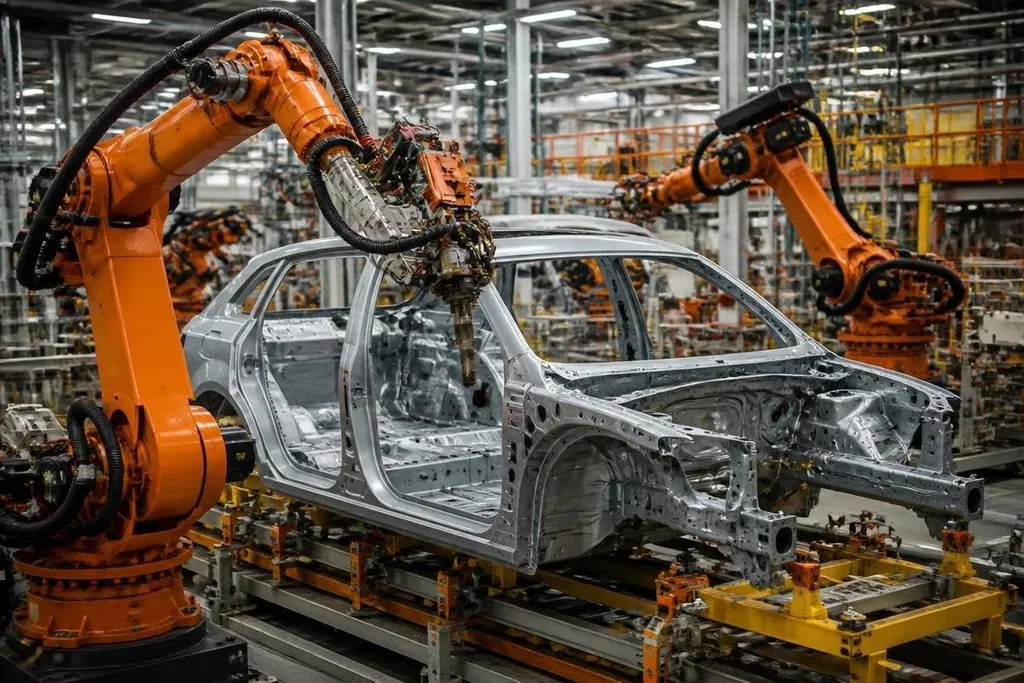
A car body moves through a factory as a planned sequence of welds, lifts, checks, and paint stages. Automotive robots now handle many of those repeated jobs, while people set up the process, manage exceptions, and inspect the result.
- Welding: robot arms join body panels with repeatable force and position.
- Inspection: cameras check gaps, welds, paint, and part fit.
- Material handling: robots move heavy parts between stations.
Where robots do the work
The body shop is the clearest example. Six-axis robot arms pick up panels, hold them in place, and make spot welds at programmed points. A spot weld joins two sheets by passing current through the metal, so the robot must keep the tool in the right position for each weld.
That repeatability matters because a small error can affect door fit, body strength, or later assembly. The robot also works at the same pace through long production runs, which gives the factory a steady process instead of relying on a person to repeat the same motion hundreds of times.
Robots also move parts that are too heavy, hot, or awkward for one person to handle. They carry batteries, glass, seats, wheels, and body panels between stations. The task still needs people nearby, since a jammed conveyor or damaged part can stop the cell until someone checks it.
Vision gives robots more to check
Older robot cells depended on fixed fixtures and tightly placed parts. Machine vision adds cameras that inspect an object before the robot acts. The system can check a panel's position, read a code, or find a gap that needs attention.
That helps when factories build several vehicle versions on one line. The robot can receive a different part or program at the next station, but the change still depends on correct software, sensors, and fixture design. A camera can't fix a badly placed part by itself.
Some factories also use LiDAR, which measures distance with laser light, to watch people and objects around a work cell. Safety systems can slow or stop a robot when someone enters a monitored area. Standards such as ISO 10218 set safety requirements for industrial robot systems, but each factory still has to test its own layout.
The factory changes around the robot
Installing a robot means changing more than one arm. Engineers must plan the gripper, welding tool, cables, safety fence, controller, fixtures, conveyor timing, and software that links the station to the wider line.
That work can take longer than the hardware installation.
A gripper that holds one door panel may fail on another version. A sensor can lose track of a part after dust builds up. A small change in panel shape can force a new robot path and a fresh safety check.
When a panel change forces a new path, Robot24 can help you trace the plant, robot, task, and date behind the result. The next question is who steps in when the cell needs that change.
People still run the process
Robots remove some repeated motions, but they don't remove the need for skilled staff. Technicians set tool positions, replace worn parts, inspect weld quality, and fix faults in the control system. Production engineers also watch cycle time, scrap, downtime, and changes between vehicle models.
Training shifts toward programming, electrical work, safety checks, and fault finding. That can change the jobs on a line, even when the factory keeps producing the same number of vehicles. The hard part is making sure the team can fix the cell when the planned sequence breaks.
I’d judge an automotive robot project by its fault recovery, not by a clean demo cycle. A station that runs well for ten minutes proves little if a worker needs an hour to restart it after one sensor failure.
Check the business case before buying
Use this checklist when you assess a robot cell:
- Name the task: record the exact motion, part, tool, and cycle time.
- Count the variants: list every vehicle version and part change the cell must handle.
- Plan recovery: write down who fixes jams, sensor faults, tool wear, and software errors.
- Check safety: test stops, access points, fencing, scanners, and restart steps on the real layout.
- Measure the result: compare output, scrap, downtime, and maintenance hours before and after installation.
The next gains will come from cells that can handle more part changes without lengthy resets. Until factories publish clear data on downtime, maintenance, and recovery time, the robot's arm speed remains less useful than the number of minutes the line keeps running.